

Share This Article
Something has shifted in the way the most interesting interiors feel right now. Not in any single city or sector but across hospitality, retail and residential design, across markets as different as London, Tokyo, Beirut and Dubai. The spaces generating the most sustained conversation, the ones people return to not just for what they offer but for how they feel, are increasingly the ones that do not look new.
This is not a trend in the conventional sense. Trends arrive with momentum, saturate a market and disappear, usually leaving behind a generation of spaces that feel dated the moment the cycle turns. What is happening with vintage sensibility in contemporary design feels different. It feels more like a reckoning. A quiet but persistent argument being made through material choices, colour palettes, furniture selections and spatial atmospheres that the visual language of earlier eras contains something the present moment is struggling to produce on its own.
Understanding why requires looking at what vintage actually means in a design context, and why it has become one of the most intellectually serious conversations in the built environment today.
What vintage actually means
The word vintage has accumulated a great deal of baggage. In popular culture it has come to mean little more than old things, thrift store finds, a filter applied to a photograph to make it look weathered. In design, the concept operates at a considerably deeper level.
Vintage sensibility in interior design is not about recreating the past. It is about understanding what particular eras of design achieved emotionally and spatially, and finding ways to carry that intelligence forward into contemporary work. It is the difference between a costume and a character. Between a space that deploys old objects as decoration and a space that genuinely understands why those objects looked the way they did, what values they embodied and what kind of human experience they were designed to support.
The most rigorous practitioners of this approach are not interior designers who love antiques. They are designers who have studied the relationship between material culture and human emotion, who understand that a particular quality of light, a specific texture underfoot, a certain warmth of colour temperature, can produce feelings of safety, familiarity and ease that the most technically sophisticated contemporary finishes sometimes cannot.
This is the deeper argument. Vintage sensibility, at its best, is not a stylistic choice. It is a human one.
The psychology of the patina
There is a reason certain spaces feel immediately comfortable. Neuroscience has begun to offer some explanation for what designers have known intuitively for generations. The human brain processes environments that contain variety, imperfection and evidence of time differently from those that are entirely uniform and pristine. Spaces with patina, with surfaces that have been worn by use, with objects that carry the marks of previous lives, activate what researchers describe as a sense of safety and continuity. They signal, at a level below conscious thought, that this place has been here before us and will endure beyond us.
This is why a cracked terracotta floor can feel more welcoming than a flawless marble one. Why a velvet chair that has lost some of its pile in the places where countless hands have rested can feel more inviting than a brand new version of the same chair. Why a room lit by lamps rather than recessed ceiling fixtures can feel more human even when the light levels are identical. The imperfection is not a flaw in these spaces. It is the point. It is doing the work that no amount of technical specification can replicate.
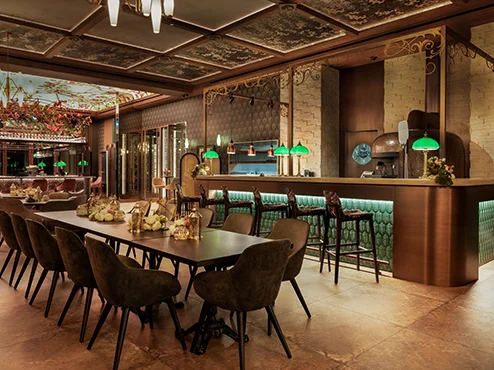
At Novecento in Dubai, designed by HTS Interiors, the palette of rich maroons, deep greens and warm earth tones is layered across the space with velvet, polished wood and bespoke metallic fixtures that prevent the nostalgia from tipping into pastiche. Every material decision is in service of a feeling rather than a literal reproduction of a decade. The space does not ask you to remember the nineties exactly as they were. It asks you to feel something warm and specific that you cannot quite name.
The difference between reference and reproduction
One of the most important distinctions in this area of design is between a space that references the past and one that reproduces it. The former is a design conversation. The latter is a museum exhibit, or a theme park.
Reproduction asks: what did this era look like? Reference asks: what did this era feel like, and how can we make a contemporary space carry some of that feeling forward in a way that is honest and alive?
The answer almost always involves editing. The best vintage inspired interiors are not comprehensive recreations of a particular decade or style. They are highly selective. A single material used with precision, a specific piece of furniture that anchors the room in a different era, a colour that carries the warmth of a particular period without literally reproducing its palette. These choices work because they are specific rather than comprehensive, evocative rather than illustrative.

H2R Design’s approach to Cassette at The Courtyard in Al Quoz demonstrates this clearly. The concept was built around music as a lived experience rather than a decorative theme. Acoustic panels were woven through the ceiling to maintain a continuous flow of soft sound. Different metals were incorporated to echo the idea of musical vibration. Globe bulbs were suspended at varying heights to mimic the visual rhythm of musical notes, with a copper cornice detail running along the walls as a reference to the cassette tape itself. Central floor tiles and glass block elements were introduced in front of the kitchen to give the space a retro, classic feel, while a neo mint palette kept the overall mood optimistic and grounded rather than heavy with nostalgia. The result is a space where the vintage reference is specific, disciplined and entirely in service of a feeling rather than an image.
Bishop Design’s work on Cubano Lito at the Ibis One Central Hotel in Dubai, completed in 2016 for the Accor Group, demonstrates perhaps the most rigorous application of this thinking. The brief was explicit in one crucial respect: embrace the language and sentiments of Cuban culture without becoming faux or thematic. That distinction, the line between genuine cultural reference and costume, is exactly where the most demanding vintage design work is done.
Every material decision in the space was in service of that brief. Raw poured concrete flooring with grit-blasted stencilled patterns referenced traditional Havana townhouses without reproducing them literally. Reclaimed palettes were used across ceiling and wall surfaces. The bar surface features piping reused directly from the site itself. Every piece of furniture was sourced from architectural salvage, including reclaimed barbers chairs fixed at the bar. A locally commissioned artist applied stencilled artwork and text that gave the space its visual voice. The result is a space that feels like it has lived a life before you arrived in it. Which is precisely the point.
Material intelligence and the role of craft
One reason vintage sensibility has become a serious conversation in contemporary design is that it has forced a renewed engagement with craft and material intelligence. The eras that vintage design draws from most frequently, broadly the period from the late nineteenth century through to the mid twentieth century, were periods in which the relationship between designer, maker and material was considerably more direct than it is today.
The introduction of industrial manufacturing, synthetic materials and eventually digital fabrication has given contemporary designers an extraordinary range of options. It has also, in many cases, severed the connection between a material and the human intelligence that once shaped it. Vintage sensibility in design is partly a response to this. A recognition that hand-finished surfaces, natural materials that age and change, objects made by processes that leave the mark of making visible, produce spaces that feel fundamentally different from those assembled from components manufactured to uniform specification.
This is not a rejection of contemporary technology. It is a recalibration. The most sophisticated contemporary studios working in this register use modern construction methods and contemporary detailing but insist on materials and finishes that carry the evidence of time or the mark of craft. The Belle Époque inspired interiors that draw on the visual language of the period, the terracotta, the carved wood, the hand-applied wallpaper, are not trying to pretend that time has stopped. They are using the material intelligence of an earlier era to produce spaces that feel more grounded and more human than their fully contemporary equivalents.
Why this matters in hospitality
The hospitality sector is where vintage sensibility has found its most commercially significant expression, and there are clear reasons for this. Hotels, restaurants and bars are in the business of producing experiences. The experience is the product. And one of the most powerful experiences a space can offer is the sense of being somewhere particular, somewhere with a history and a character that could not have been conjured from nothing.
In a global hospitality landscape increasingly saturated with spaces that feel interchangeable, the vintage register offers something that contemporary minimalism, however refined, cannot easily replicate: specificity. A space that feels as though it belongs to a particular moment in time, a particular cultural tradition, a particular idea of how people should live and gather and eat, is a space that gives people a genuine reason to choose it over the alternative.
This is why the most thoughtful hospitality operators in markets like Dubai are investing in design that reaches backward, not because they are retreating from the present but because they understand that the most memorable experiences are rarely the most technologically advanced. They are the most human.
The conversation the industry is having
Vintage sensibility in design is not without its tensions. There are legitimate questions about authenticity: when does inspired by become derivative? When does the use of a historical visual language become appropriation rather than interpretation? These are questions that serious designers in this space think about carefully, and the answers are almost always found in the specificity and honesty of the reference rather than its breadth.
There are also questions about the relationship between vintage design and sustainability. The reuse of existing buildings, the integration of salvaged materials, the preference for natural and durable finishes over synthetic and disposable ones: these are practices that the vintage register tends to encourage, and they align well with the broader push in the built environment toward more responsible design. The patina that gives a vintage inspired space its character is often the patina of genuine age, of materials that have lasted because they were made to last.
This may be the deepest reason why vintage sensibility has found such a serious place in contemporary design thinking. In an industry reckoning with questions of durability, responsibility and the long-term impact of the built environment on the world we share, the choice to design spaces that feel as though they have already endured, and that might endure for decades more, is not merely an aesthetic position. It is an ethical one.
