

Share This Article
Dubai has never been short of restaurants. The city has spent two decades building one of the most competitive dining scenes in the world, attracting the world’s best chefs and brands and pairing them with addresses that would make any other city envious. But something has shifted in the conversation around what makes a Dubai restaurant worth talking about. Food alone is no longer enough. The room has to earn its place too.
This is not about spectacle for its own sake. The most interesting restaurant interiors being produced in Dubai right now are not simply dramatic. They are deliberate. They tell stories, carry cultural references, respond to the space they inhabit and create an atmosphere that food and service alone cannot manufacture. The designer’s name belongs in the conversation alongside the chef’s.
Here are five Dubai restaurants where the interior earns its own review.
Josette – ICD Brookfield Place, DIFC
Designed by Luke Edward Hall
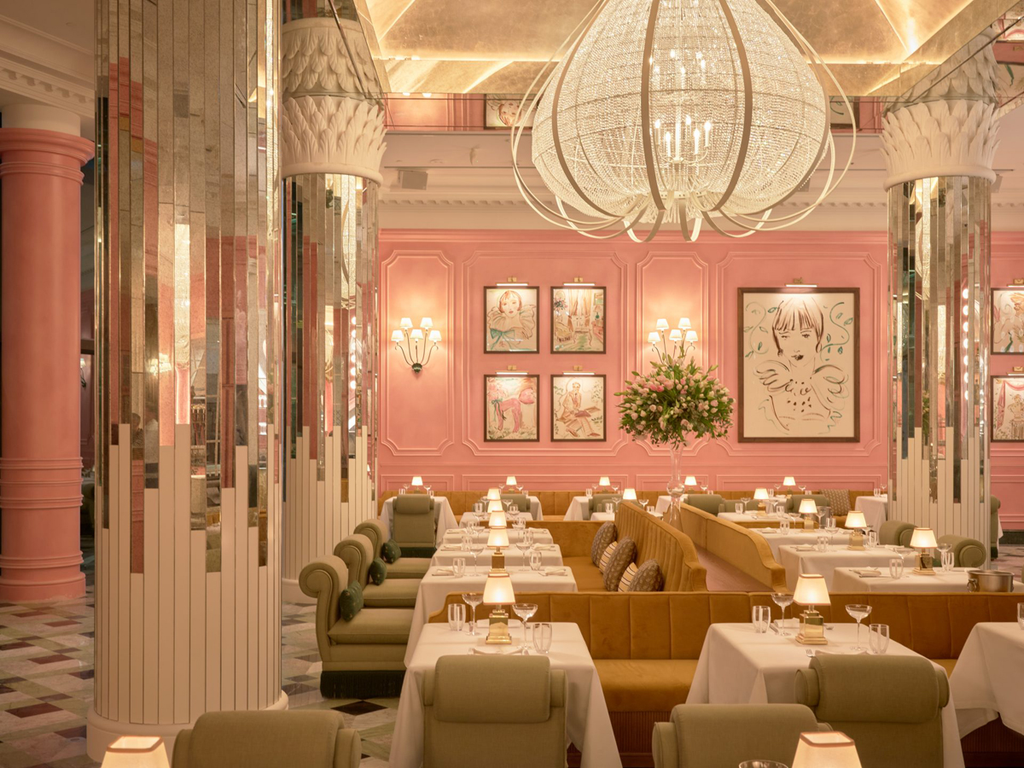
There are restaurants that feel designed and restaurants that feel dreamed. Josette, tucked inside ICD Brookfield Place in DIFC, falls firmly into the second category. Walk through its golden revolving doors and you arrive inside what can only be described as a Parisian fever dream, one where champagne arrives at the touch of a button, live cabaret acts emerge from behind emerald velvet curtains and every surface is doing something interesting.
The interiors are the work of British designer Luke Edward Hall, whose credits extend to Amaru in St Moritz and the boutique Hotel Les Deux Gares in Paris. His signature is a kind of maximalism that never tips into clutter, where pastel pink walls carry playful framed line drawings, mustard banquettes sit beneath oversized crystal chandeliers and a grand green marble bar runs the full length of the back wall, framed by ornate cartouche plasterwork.
What Hall achieves at Josette is a space that feels entirely specific. Not a generic French brasserie dressed up for Dubai but a place with a point of view, a colour palette and a sensibility that could only have come from one designer’s imagination. In a city where restaurants can sometimes feel interchangeable, that specificity is worth something.
Leña – St Regis Gardens, Palm Jumeirah
Designed by Astet Studio

The original Leña in Marbella was named the world’s most beautiful restaurant in 2021. When chef Dani Garcia’s steakhouse opened its Dubai outpost at the St Regis Gardens on Palm Jumeirah at the start of 2024, the design team at Astet Studio faced a genuinely difficult brief: bring the fire-inspired visual language of the original to a completely new context without simply recreating it.
The result is one of the most atmospherically coherent interiors in Dubai. Everything in the space speaks the same visual language. Burnt orange banquettes, copper finishings and thick beds of dehydrated pampas establish the palette. Above, swirls of wood spread across the ceiling mimicking the pattern of a flame, gradually darkening in colour until they become ash. The effect is not decorative. It is structural. The ceiling is telling you exactly what kind of restaurant you are in before a single dish arrives.
Outside, a dramatic square bar sits at the heart of a spacious terrace lined with trees and warm-lit lanterns. Even the alfresco space maintains the same visual logic. Nothing is incidental. The commitment to the idea, from the first material choice to the last detail of the lighting plan, is what elevates Leña from a beautiful room into a genuinely considered piece of design.
Gigi Rigolatto – J1 Beach
Designed by Hugo Toro
The brief that French-Mexican architect Hugo Toro received for Gigi Rigolatto at J1 Beach was, on paper, simple: create the feeling of a Mediterranean garden. What he delivered across 5,000 square metres is something considerably more ambitious than that description suggests.
Outside, winding wooden paths move through bougainvilleas, jasmine, ficus, olive and lemon trees surrounding a sapphire blue pool, creating what feels less like a restaurant garden and more like a genuine Mediterranean landscape transplanted to the Dubai waterfront. Inside, the 120-seat restaurant is designed to feel like a grand rustic Italian home, with tables set beneath high red brick archways and towering olive trees bringing the garden indoors. Embroidered linens and a covered terrace extend the same warm, unhurried domestic quality into every corner of the space.
What makes Toro’s approach interesting is the commitment to materiality and planting as primary design tools rather than finishing elements. The architecture does not contain the garden. The garden is the architecture. The result is a space that feels genuinely rooted in its landscape rather than placed upon it, which is a considerably rarer achievement in Dubai’s restaurant scene than it should be.
The Guild – ICD Brookfield Place, DIFC
Designed by Archer Humphryes Architects
The Guild is one of the most ambitious restaurant projects Dubai has seen in recent years, and Archer Humphryes Architects, the same firm behind London’s Chiltern Firehouse, were given the scale to match that ambition. Across 20,000 square feet inside ICD Brookfield Place, the practice designed not one restaurant but several, each with a distinct identity, all flowing into each other as a single coherent experience.
The journey begins in the Nurseries, where plant-lined red brick tiled floors and a leafy boulevard atmosphere set an expectation of considered detail. Turn the corner and the full scale of the project reveals itself. The Rockpool seats diners around a living rockpool housing North Atlantic lobsters, brown crab and oysters. The Salon places white-clothed tables beneath crystal chandeliers with large open red-brick wood-fire ovens visible behind. A patisserie, champagne bar, seafood restaurant, grand dining room and piano bar complete the offering.
The challenge of designing multiple distinct spaces that still feel like one place is one of the hardest problems in hospitality design. Archer Humphryes solve it here by establishing a consistent material vocabulary, the brick, the timber, the warm lighting, the plants, and varying it across contexts rather than starting fresh in each room. The result is a space that rewards exploration and feels richer with every area you discover.
Bisou – Dubai Opera Plaza, Downtown Dubai
Designed by Tristan Du Plessis
South African architect Tristan Du Plessis was given an extraordinary canvas for Bisou: a two-storey space within the circular confines of the Dubai Opera House, with floor-to-ceiling windows looking directly onto the Burj Lake and the city’s famous fountain show beyond. The brief, as conceived, was equally extraordinary. Design a restaurant inspired by a love story between an Arabic poet and a French librarian.
The result is a space of genuine romantic theatre. At its heart, a grand sweeping staircase rises through the room, above which floating white buttercup lanterns hang at varying heights. Crystal chandeliers drop from folded fabric ceilings. Blush pink velvet chairs sit on chequered monochrome floors. Black and white flecked marble runs throughout, while the Gothic aspects of the French influence are visible in the architectural details and the structural drama of the room’s proportions.
What Du Plessis achieves is a space that takes its narrative premise seriously. The love story is not a caption in the press release. It is embedded in every material choice, every colour decision and every spatial gesture. The Arabic and the French exist in deliberate tension across the room, and that tension is precisely what makes the interior feel alive rather than merely decorated.
Dubai’s best restaurant interiors are not beautiful by accident. They are the result of designers who understand that a room is not a backdrop but an argument. An argument for a particular way of experiencing time, food and company. The five designers behind these spaces have each made that argument with intelligence, commitment and genuine skill. The next time you book a table at any of them, arrive early. Give yourself time to look.
The built environment has a publication. This is it. thepageshub.com | edits@thepageshub.com
Your story deserves to be told. Get featured on PAGES at edits@thepageshub.com
