


Share This Article
Isiah Villanueva did not arrive here in a straight line. Few people who are genuinely good at what they do ever do. What pulled him into the built environment was not a single defining moment or a grand professional vision. It was something quieter and more human: the space that exists between people and the spaces they live and work in.
In business development, Isiah found a profession that suited both his instincts and his values. At its core, business development is about understanding what someone is trying to build and then matching it to something real you can make. But what changed the way he saw his work entirely was not a promotion or a trophy on a shelf. It was the people. Sitting across from individuals from all walks of life, listening to their journeys and understanding what they were really working toward. In a close industry like this one, he realised early that success is never transactional. It is relational. And it is about lifting others up.
Long ago, his father gave him a simple truth that still serves as his compass today. Your primary job in life is to help people. That lesson anchors his days and is the exact reason he loves what he does.
Today, Isiah brings that compass to his work across two distinct but complementary businesses: Cultivate, a biophilic and landscaping design practice, and The Dream Lab, a fiberglass fabrication studio. Between them, he has built a career at the intersection of nature, craft and the human experience of space.
Relationships first, selling second
Isiah’s approach to business development is clear and deliberately ordered. Relationships come first. Selling comes second. Before he talks about what either company offers, he wants to understand the client’s actual problem, their budget reality and the pressure they are under to deliver.
Doing the job well, in his eyes, means the client trusts that he will tell them the truth, even when the truth is that something will cost more or take longer than they hoped. It also means knowing the product deeply. He cannot represent biophilic design or fiberglass fabrication credibly if he does not understand how the work actually gets made. That depth of knowledge is not a nice-to-have. It is the foundation of every honest conversation he has with a client.
The real proof that he has done the job right, he says, is simple: when a client comes back for the next project without him chasing them.
What the industry is now asking for
The shift Isiah thinks about most in the built environment today is how client expectations in this region have changed. It is a meaningful shift and one he finds genuinely encouraging. Clients used to ask for landscaping or fabrication as decoration. Now they ask what it does for the people who use the space. Whether that is wellbeing in an office, safety in a children’s play area or how a design holds up over time in this climate. The conversation has moved from appearance to purpose. From aesthetics to experience. And that is exactly where the most interesting work is being done.
On the manufacturing side, there is real and ongoing pressure around materials and standards, fire retardant requirements, reliable sourcing when regional stock runs short, the kind of complexity that never makes it into a proposal but shapes every delivery. Isiah’s response is to stay close to both the client and the production team so that he is never promising something that cannot be delivered well. He would rather have a harder conversation early than disappoint someone at handover.
One recent project tested that commitment directly. It had started as a dream: a major job secured, details finalised, full payment received upfront. Then external circumstances intervened. The project went on hold. The client went quiet for three months. When they resurfaced, everything had shifted: major design revisions arrived alongside a sharp rise in global raw material prices. The original budget no longer held, and a variation order for a price increase became unavoidable. The client pushed back. For nearly two weeks, the conversation went in circles.
The breakthrough came when Isiah stopped working around the numbers and laid everything on the table: the shifting overheads, the material scarcity, the new scope. Trading defensiveness for full transparency was what got both parties to common ground. The project is in production today. That outcome confirmed something he already believed: when a project stalls, honest communication is the only way through.
A no is usually a not yet
If Isiah could go back and tell his younger self one thing, it is this: a no is usually a not yet.
Early in his career, he read every rejection as a closed door and burned energy trying to force deals that were not ready. It took years to understand that timing matters as much as the pitch. That staying genuinely useful to someone, even when there is nothing in it for him that month, is what brings them back when the timing is finally right.
Patience in this work, he has learned, is not passive. It is a strategy. And it is one that has quietly shaped every strong relationship he has built in the industry.
Success measured by what outlasts the contract
When Isiah started out, success was the close. The signed contract and the number attached to it. That still matters. But his definition has widened considerably.
Now he measures success by whether a client comes back. Whether they refer the business to someone they care about. Whether the relationship outlasts a single project. These are the signals that the work was done right and that the trust was earned rather than assumed.
Beyond the tangible, his definition of success is tied to something he calls legacy. It is the quiet pride of watching someone he has invested time, energy or advice in step into their own light. When the people around him succeed, whether they are breaking through professional ceilings or finding happiness in their personal lives, that is when he knows he is doing something right. Success, for Isiah, has never been solely about what he builds. It is equally about what the people around him become.
The people who showed up
Isiah closes with gratitude that is warm, specific and deeply felt. He gives an immense thank you to his life mentors, Ryan and Joanna Ramos of Cultivate Brands UAE, for their guidance and the vision they have shared with him. He credits his big sisters in the industry, Cheryll of Stellar Concepts Interiors and Christine of Godwin Austen Johnson, for constantly cheering him on and anchoring him with their wisdom and experience.
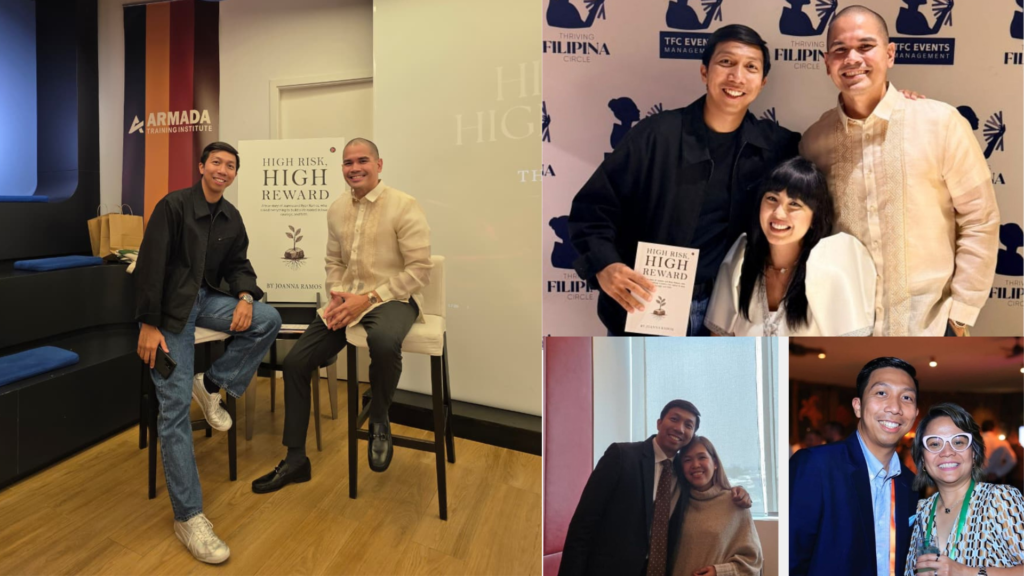
And with the pride of someone who carries his heritage into every room he walks into: Mabuhay ang Filipino.
Isiah Villanueva is a Business Development professional at The Dream Lab and Cultivate Brands UAE. This piece is part of The Minds Behind the Build, PAGES’ ongoing series celebrating the founders and leaders shaping the built environment.
