


Share This Article
Feelings of familiarity signal safety. They act as biological cues that tell us we are somewhere secure. Whether stepping into a mosque, a family home or the gardens, schools and palaces that stretch from Iraq and Saudi Arabia to Spain and South Asia, the neurons responsible for processing comfort and recognition are quietly activated.
In its literal sense, Islamic architecture refers to buildings constructed under Islamic rule or shaped by Islam’s cultural influence. Yet its visual language has expanded far beyond that definition. Characteristic geometric and arabesque patterns have travelled from monumental architecture into markets, family homes and now even coffee coasters.
Islamic maximalism, expressed through recursive geometry, arabesque patterns, domes, minarets, mosaics and calligraphy, challenges the familiar modernist idea that less is more, a minimalist philosophy that can often feel sanitised and, frankly, a little boring. Instead, it embraces abundance, celebrating ornament as something that carries history, mathematics, regional identity and craftsmanship. Whether found in a centuries-old mosque in Isfahan, the tiled interiors of Istanbul’s Blue Mosque or an unassuming villa in Dubai, decoration becomes far more than embellishment. It is architecture’s way of telling stories.
The Friday Mosque, Isfahan, Iran
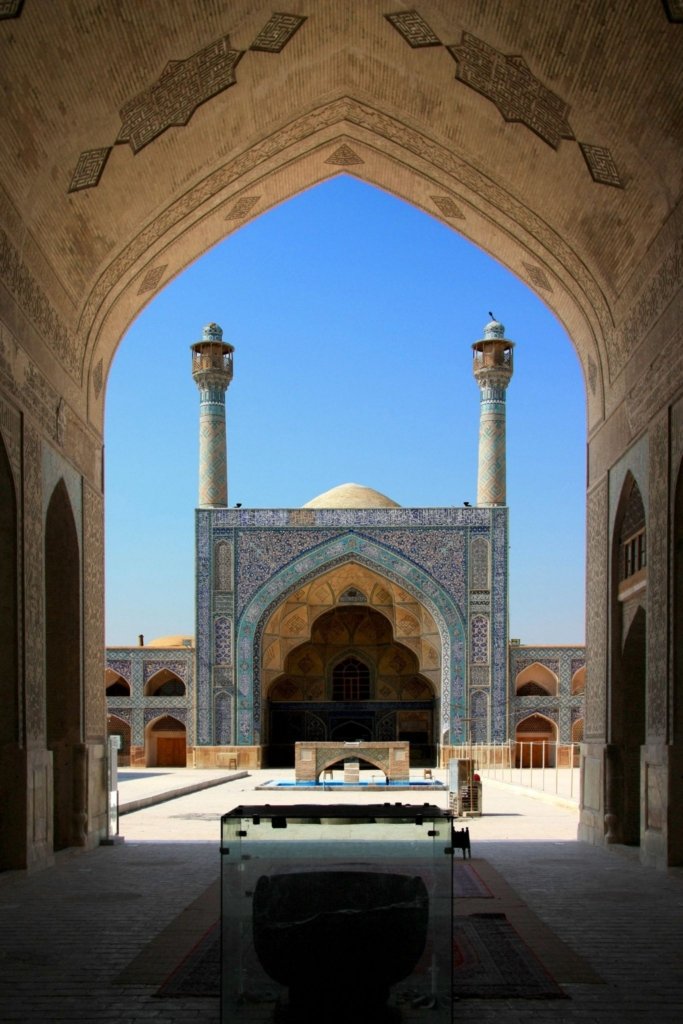
The Friday Mosque in Isfahan brings together more than twelve centuries of Islamic architectural development within a single complex. Its interior is defined by geometric brickwork, muqarnas, carved stucco and intricate tilework, with each period adding another layer of craftsmanship rather than replacing what came before. The Nizam al-Mulk dome marked an important development in the use of the double-shelled ribbed dome, combining structural engineering with geometric design. Looking across the ceilings, vaults and walls, it becomes clear that mathematics has never sat separately from Islamic architecture. It has always been embedded within its decoration and construction.
The Villa Between Al Quoz and Ghadeer Al Tair, Dubai
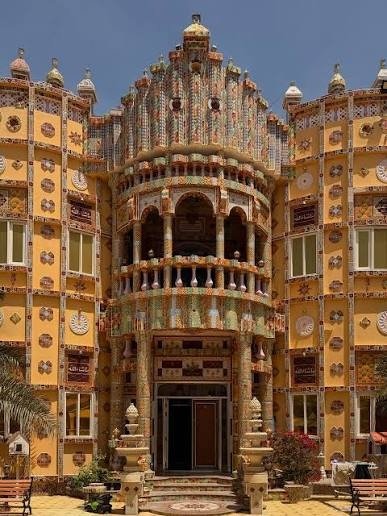
While monuments like Isfahan reveal the mathematical sophistication of Islamic architecture at its grandest, the same visual language has long existed in the everyday spaces of domestic life. Tucked between Al Quoz and Ghadeer Al Tair is a villa that has become something of a local curiosity. Its façade is covered in mosaics, geometric patterns and Qur’anic calligraphic panels, embracing the same richness of colour, ornament and detail found across the Islamic world. Little is known about who built it. Islamic maximalism is not confined to heritage sites or architecture books. It continues to exist in the homes, streets and neighbourhoods that rarely make it into either. Architectural traditions, it turns out, shape contemporary homes as powerfully as they shape monuments.
Putra Mosque, Putrajaya, Malaysia
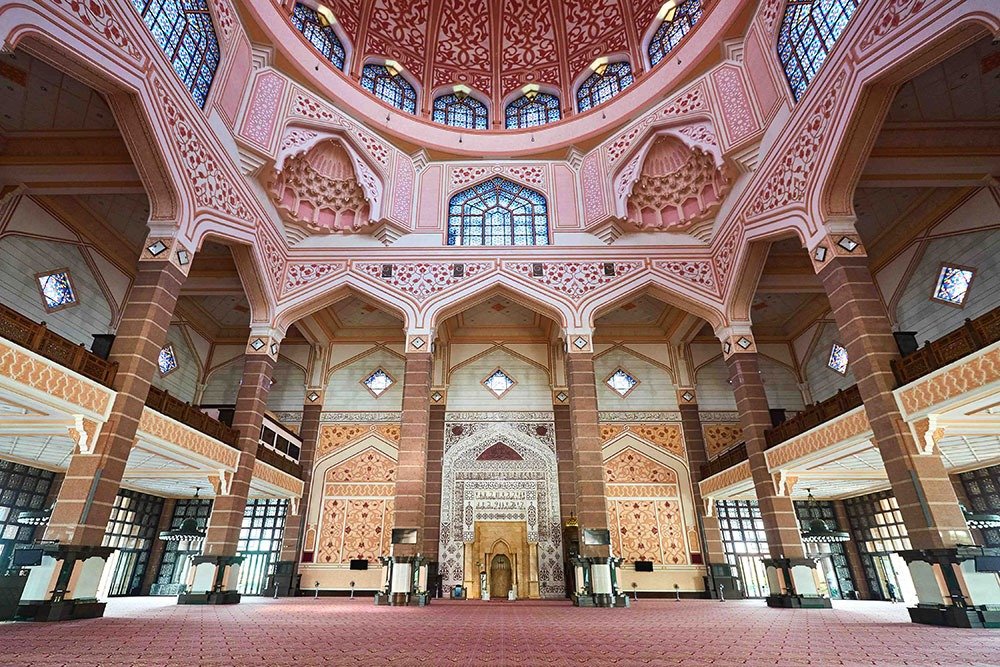
Islamic maximalism has never belonged to one region alone. As Islam spread across continents, local materials, climates and traditions reshaped its architectural vocabulary while preserving its underlying principles. Completed in 1999, the Putra Mosque brings together Malay, Persian, North African and Arab architectural influences, with its rose-tinted granite façade and distinctive pink dome making it one of the few pink mosques in the world. Inside, geometric patterns, ornamented ceilings and intricately detailed surfaces reflect centuries of architectural exchange across the Islamic world. Rather than drawing from a single tradition, the mosque demonstrates how regional influences have continually and beautifully shaped a shared architectural language.
The Dome of the Rock, Jerusalem
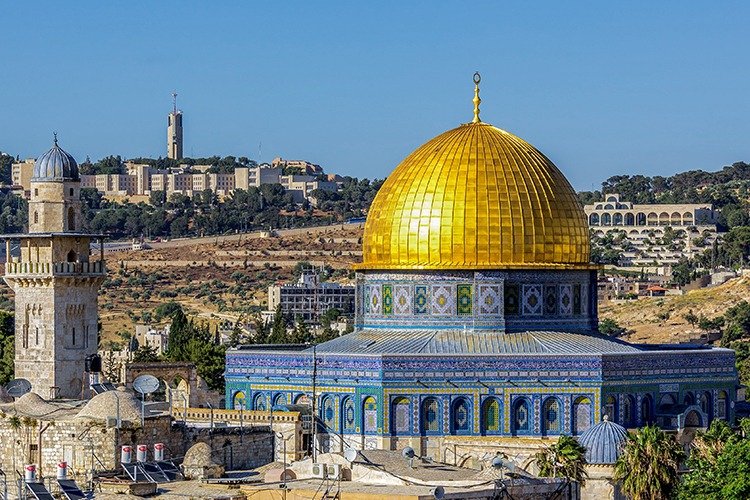
Looking further across the Islamic world, one of its earliest surviving monuments demonstrates just how enduring this visual language has become. Sitting atop the Haram al-Sharif, the highest point in Jerusalem’s Old City, the Dome of the Rock has dominated the city’s skyline since the late seventh century. Its gold-coloured dome and Turkish faience tiles have made it one of the most recognisable monuments of the Islamic world. Although often mistaken for a mosque, it is a shrine, and scholars continue to debate its original function. Inside, mosaics cover its surfaces with vegetal scrolls, crowns and geometric motifs, deliberately avoiding human and animal figures. Fourteenth-century traveller Ibn Battuta wrote that the greater part is covered with gold so that the eyes of one who gazes on its beauties are dazzled by its brilliance.
The Blue Mosque, Istanbul, Türkiye
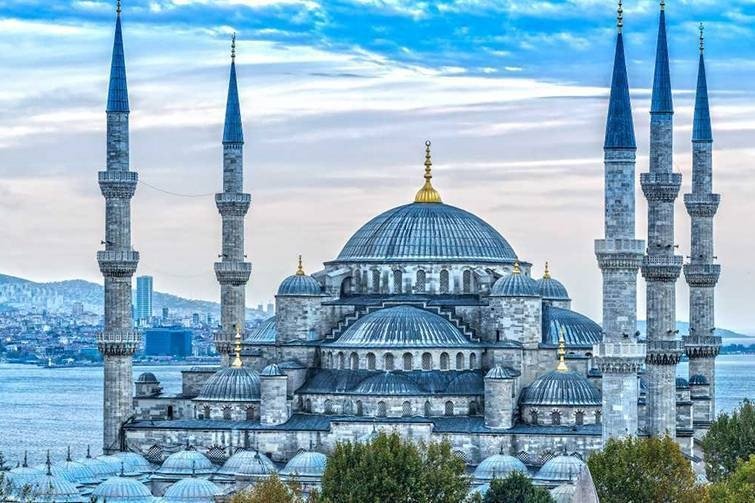
Centuries later, Ottoman architects would continue and deepen this tradition. The Blue Mosque, facing the Hagia Sophia in Istanbul, was built in the early seventeenth century as an Ottoman imperial mosque. Designed by Sedefkar Mehmed Agha, its cascading domes and six minarets create a strikingly symmetrical exterior, while the interior is lined with more than 20,000 İznik tiles, geometric patterns, floral motifs and Qur’anic calligraphy. Coloured light filters through stained-glass windows, adding another layer of ornament to the space, and another chapter to a story that began centuries before.
Islamic architecture has never been a singular style. From the central domes of the Ottomans and the hypostyle halls of North Africa to the Persian geometry of Isfahan and the local materials of South Asia, it has continually evolved through regional traditions without losing the visual language that binds it together. Domes, minarets, mosaics, arabesque patterns and geometric repetition remain part of a shared architectural vocabulary that continues to adapt across time and place.
As Professor Doaa Ismail Attia writes, the recursive geometry and biomorphic patterns found throughout Islamic architecture echo the natural world itself, from the branching of trees to the networks of the human brain. Perhaps this is why these spaces continue to feel so deeply familiar, why stepping into a mosque or a family home decorated in this tradition activates something instinctive and secure. Whether understood through faith, mathematics or design, they remind us that ornament has never been about excess. It is about creating places that feel alive, where beauty is not an afterthought but part of architecture’s very foundation.
