

Share This Article
There are photographers who capture spaces. And then there are those who understand them. Alex Jeffries, Founder of Alex Jeffries Photography Group, belongs firmly in the second category. His work sits at the intersection of design literacy and technical precision, and the built environment is better documented because of it.
The beginning, like many great creative paths, started with a teacher who saw something worth nurturing. A school art education that opened his eyes to composition, structure and the history of visual culture. An after-school photography class that gave him somewhere to put it all. And a natural, almost instinctive pull toward interiors, architecture and hospitality spaces, toward the balance, the atmosphere and the quiet but powerful way a well-designed space can influence how a person feels without them quite knowing why.
As he developed professionally, Alex realised that interior and architectural photography suited both sides of his personality. The creative and the technical. The expressive and the precise. In a field where every line, every reflection and every light source is visible and nothing can truly be hidden, that duality is not just useful. It is essential.
Reading a room before the camera does
Ask Alex what happens when he walks into a space for the first time and his answer reveals a great deal about his approach. By the time he arrives to photograph a project, he already knows it well. Renders reviewed, design intent discussed, site visits completed where possible. The camera comes later. The understanding comes first.
Once on site, he is immediately studying the light: how it falls across materials and surfaces, where the challenges are likely to sit, what will need adjusting before a single frame is captured. Clutter that needs removing. Furniture positioning that needs refining. Operational realities that could compromise the image.
The goal, he is clear, is not simply to find an interesting angle. It is to communicate the space honestly and intentionally, to make the image feel calm, refined and commercially strong. And always with an awareness of how those images will ultimately be used, whether for editorial coverage, brand campaigns, hotel marketing or awards submissions. Every decision is made in service of that purpose.
Training the eye
Alex traces the development of his visual intelligence back to his art education and later his studies in graphic design, years spent thinking seriously about composition, colour theory, typography, balance and weight within layouts and images. That foundation, he says, changed the way he sees photographs.
Taking a visually attractive photograph can sometimes be the easier part. The deeper challenge is understanding why an image works, how it communicates, how it guides the eye and how it serves a purpose both commercially and emotionally. That level of understanding takes time and it takes honest feedback.
It is why Alex has invested consistently in professional development through organisations such as the British Institute of Professional Photography and the Master Photographers Association in the UK. What those organisations gave him, beyond technical knowledge, was the ability to accept critique properly. To analyse his own work more honestly. To discuss composition and symmetry in depth and to continuously push his own standards higher. That process, he notes, never really stops. You simply continue refining your eye year after year.
When the brief gets complicated
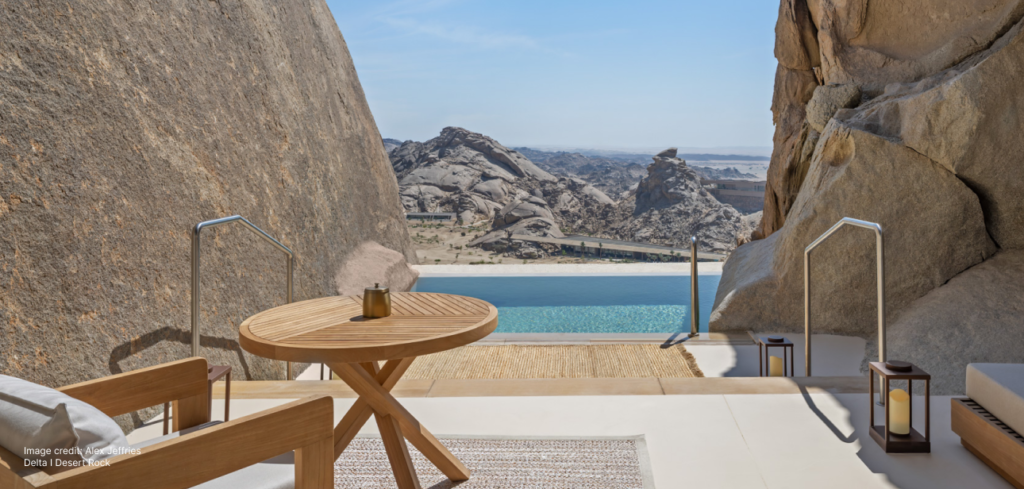
Every project presents its own challenges and Alex has encountered more than most. Photographing at the world’s highest infinity pool in extremely high winds. Working against the immovable pre-opening deadlines of major hotel launches. Navigating locations where drones were the only viable option but restricted from use. And at Desert Rock Resort in the Red Sea, working with a sunset window that lasted only a few minutes each evening, where timing and preparation had to be absolutely precise.
What experiences like these teach you, he reflects, is that there is no room for drama or panic. There is simply a brief, an expectation and a series of challenges that need solving professionally. You learn to prepare properly, adapt quickly and stay calm under pressure. In many ways, problem-solving becomes just as important as the photography itself.

Trust is the real currency
In an industry full of talented designers and architects, Alex has built relationships with some of the most respected hospitality brands in Dubai and across the region. When asked how that happens, his answer is refreshingly simple.
You do good work and you do it consistently.
There is no formula for becoming brand-approved by major hospitality groups beyond that. Trust is built over time, through quality delivered professionally from the first conversation to the final image. When clients no longer need to worry about the photography, when they know the process will be calm, organised and handled with complete professionalism, the relationship shifts. You stop being a supplier and become a reliable external partner.
At a certain point, he says, the conversation becomes very simple. The project is ready. Get Alex in to complete the photography. No drama, no stress. Just consistently strong work.
What a great photograph actually is
Alex’s definition of a great photograph has changed significantly since he began. Early in his career, he believed he had already reached a solid technical level. It was only when he started having his work professionally critiqued that he realised how much further there was to go. He began seeing mistakes he had previously missed. He started looking more deeply into composition, balance, perspective, lighting and detail.
Today, his definition of a great photograph is less about drama and more about intention. About restraint. About creating something balanced and lasting rather than something immediately striking. Sometimes, he says, the strongest image is the simplest one. That is the kind of understanding that only comes with years of honest self-examination and a genuine commitment to the craft.
One piece of advice
For anyone wanting to pursue architectural or interior photography, Alex’s advice is straightforward and worth taking seriously.
Do not stop training. Study art if you have not already. Learn composition properly. Learn to understand light beyond simply using a camera. Find mentors. Join professional organisations. Put your work in front of people who will critique it honestly rather than simply praise it. And stay humble enough to keep learning.
Photography, he reflects, is one of those professions where the more experienced you become, the more you realise there is still to improve. It is not a destination. It is a direction.
Alex Jeffries is the Founder of Alex Jeffries Photography Group. This piece is part of The Minds Behind the Build, PAGES’ ongoing series celebrating the founders and leaders shaping the built environment.
